
Réhabiliter Jimi Hendrix
English version · automatic translation
Rehabilitating Jimi Hendrix
Rehabilitating Jimi Hendrix
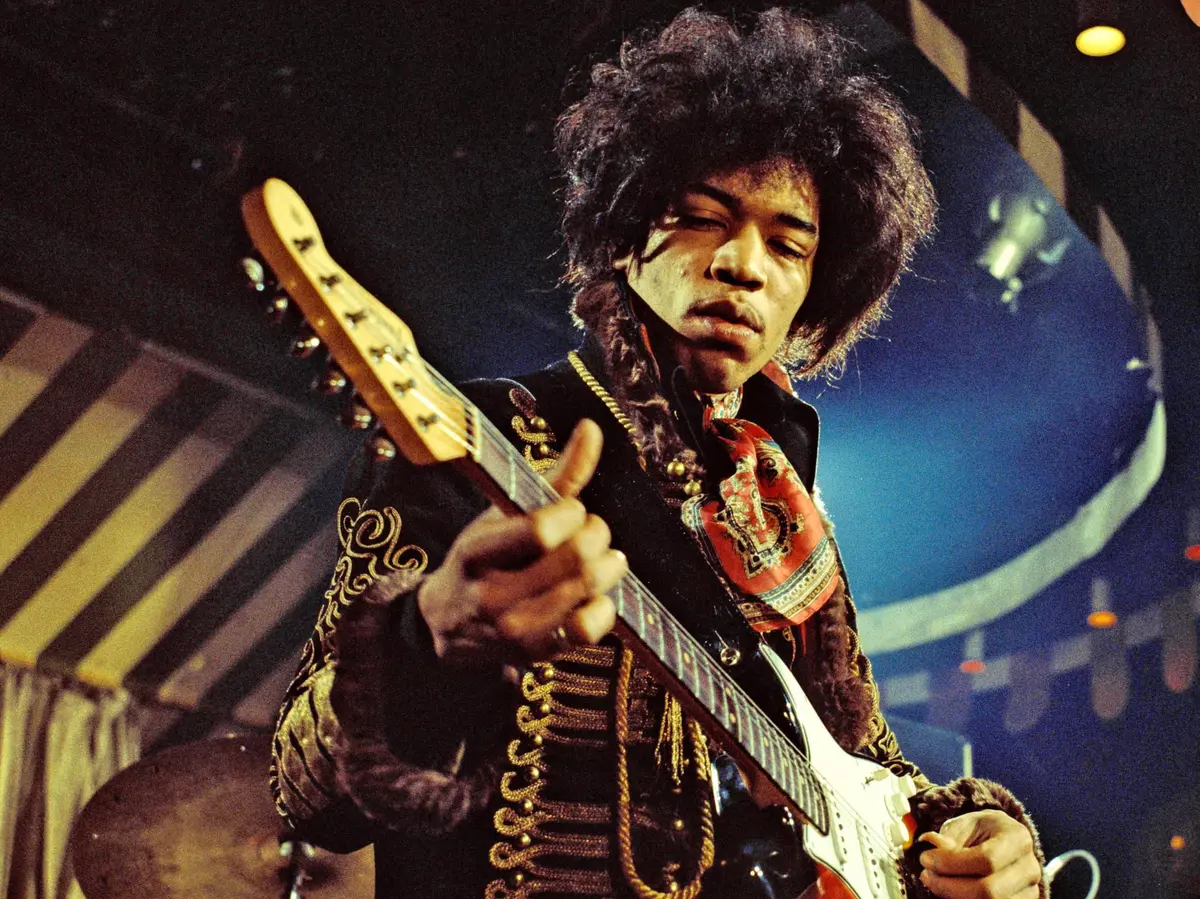
The title of this article is admittedly curious. Jimi Hendrix is regularly cited as the best guitarist in history. Everyone agrees that his music is essential to rock’n’roll and that he is certainly one of the most respectable human beings of all time. And yet the fact is that it is not “hype” to talk about Jimi Hendrix, to post his music on social networks, to say you are influenced by him or to write articles about him. So his cool needs to be rehabilitated!
Just look at what the cool press thinks of him: in one article, Gonzaï celebrates “a way of saying that we don’t give a damn about Jimi Hendrix and that nobody listens to a rotten band like the Who anymore“. Pitchfork lists only 24 results for Jimi Hendrix, and Magic does even better with just 4 results since January 1, 2008. In their defense, the magazine covers pop, modern pop, but even so. That does not stop these various magazines from slipping in a few kind words about Jimi Hendrix, but one has to admit that we are far from the cool generated by the Stooges, the Velvet or Sonic Youth, all bands that should, by the way, be worshipped.
In fact, you have to go to the “mainstream rock” magazines to find some glowing words about him, I am thinking of Les Inrocks or Rock & Folk. None of that will help rehabilitate him in more underground circles. And let it be said right away: the point is not to impose Jimi Hendrix on every newsroom in the world, but 1/ to question the lack of cool that surrounds him and 2/ to recall a few facts on the matter.
There was a time when it was cool to claim Jimi Hendrix as an influence; proof is, Miles Davis did! And if Jimi is no longer the independent symbol he should be, a few reasons may explain it. Perhaps a fantasized closeness to the dad rock, geek scene of Led Zeppelin is the cause. Perhaps it is his historical distance; in the end, few sixties bands are cited as absolute references apart from the Beatles. Perhaps his music is too little known, most of the public stopping at “Voodoo Child” and “Foxy Lady“. Perhaps, finally, it is his blues influences that tend to disqualify him; who still listens to the blues regularly apart from a few diehards, of whom yours truly is one.
In reality, without Jimi Hendrix no Stooges, without the Stooges no punk, and without punk no modern rock’n’roll as we know it. And that is not all! Forget Tame Impala, King Gizzard & The Lizard Wizard and the current psychedelic scene too. Ouch. The fact is that Jimi Hendrix is one of the last generalist explorers, if not the last, to have transcended several musical genres in this way.
He was obviously a punk ahead of his time; as proof I offer the story behind the cover of Electric Ladyland (1968). After he had asked for a photo by Linda Eastman to be used, his American label blithely decided to ignore him, using an image by Karl Ferris instead. The European label, Track Records, for its part, called on David Montgomery, who took that cult photo of 19 naked women (8 on the reduced version). Hendrix was quick to voice his displeasure: « Folks in Britain are kicking against the cover. Man, I don’t blame them. I wouldn’t have put this picture on the sleeve myself, but it wasn’t my decision. It’s mostly all bulls » (in French: « les gars en Angleterre se plaignent de la pochette. Je ne peux pas leur en vouloir. Je n’aurais pas choisi cette image moi-même, mais la décision ne m’appartenait pas. C’est des conneries »). Some retailers refused to stock the album and others turned the cover inside out.
Jimi Hendrix was also an absolute master of psychedelic music (“Third Stone From The Sun“), of blues rock (“Voodoo Chid“, “Red House” and “South Saturn Delta“) and even of pop (“3 Little Bears“)… More than that, Jimi Hendrix’s music is incredibly brutal, and yet several tracks are among the best produced in history, I am thinking in particular of the studio version of “Crosstown Trafic”, which in my view is unequaled!
I am not going to go through Jimi Hendrix’s discography again, but one has to acknowledge that every track he ever produced deserves a place in your record collection. This guy touched many musical styles and always brought something to them, never falling into too much.
In reality, Jimi Hendrix is not just the simple translation of a movement; he is a starting point. Some time ago now, I wrote that the Clash had only ever translated the punk revolt of English youth, and more generally, that rock’n’roll was the expression of a youthful state of mind. I do not take back any of those words, but I add the nuance of the very greatest: without Jimi Hendrix, rock’n’roll would not have taken the same turn, and no one else would have come along to take his place. The same goes for the Beatles and a few others, including Pavement, which gave birth to slackerism. Without them, the scene would be very different today, and anyone who says they love what comes out in the 2010s must therefore credit these founding fathers with shaping its spirit.
This is done too rarely. It must be said that we are too used to “translation artists”. That is the thesis developed by Matt Ridley in his Evolution of Everything. The demonstration is relentless: we constantly revisit history through great men, as if they had a providential importance. In reality, jazz would have appeared without the first jazzman, rock’n’roll would be what it is without Chuck Berry, and America would have been discovered all the same without one chance ship. All of that is true, and every rule has its exceptions, including Jimi Hendrix and a handful of artists. And if that does not earn the cool of circles that call themselves cool, I would rather be uncool with my Jimi as a reference than hype with my My Bloody Valentine albums under my arm.
Original version (French)
Réhabiliter Jimi Hendrix
