
Anachronique ·

Erectus Monotone (Discordant Pop)
English version · automatic translation

Anachronique: Erectus Monotone (Discordant Pop)

Some of you noticed that the recent Still in Rock mixtape, Nineties, Again!, gave pride of place to several bands that have never been reviewed here. Erectus Monotone is one of them.

Erectus Monotone is a band from Chapel Hill. Is it the greatest wasted talent of the scene at the time? Some say so. Erectus Monotone is Kevin Collins (guitar and vocals), Andy Freeburn (guitar and vocals, too) and Jennifer Barwick (bass and… vocals, sometimes). As for the drummer’s role, it was held by four different musicians. As the story goes, the day Dave Brylawski (Polvo’s guitarist) heard Erectus Monotone for the first time, he was so shocked that he refused to go back into the studio: “That was the first we’d ever heard them play with Mike Meadows, and we were blown away, like, ‘Oh my god.’ They came out, and we’re like, ‘No, we’re not playing you the demo“.

There is, in Erectus Monotone’s music, a very deconstructed side that does indeed bring to mind Slint, Polvo and all those cathartic indie rock bands. While the style has since become widespread, it did not seem obvious in the 90s. But Erectus Monotone does not play only on that turf. Its music, often blackish and hazy, also has the sensual side of Blonde Redhead as well as the metallurgical melodies of Sonic Youth. That’s a lot, you’ll tell me, all the more so for such a little-known band. But Erectus Monotone never gives the feeling of a mess, its songs are perfectly made, in short, here is a 90s essential, despite its openly embraced outsider status.

As with a great many bands of the time, there seems to be a desire to kill pop on this album. It is surely the result of a pendulum swing that, to make up for the excess of the ’80s, wanted to produce anti-melodic albums. As its label at the time put it, Erectus Monotone wanted to play “short, sweet, discordant pop with no guitar solos”. I wonder whether the approach was supported by the label or whether, on the contrary, it pushed the band to make itself more “accessible”. What was the mindset in those indie labels back then? If you have some intelligible reading on the subject, I’ll take it (thibault@stillinrock.com). As for the rest, I am forced to note how perfectly Erectus Monotone achieves its goal. Never does the band offer us the slightest break in the clouds.

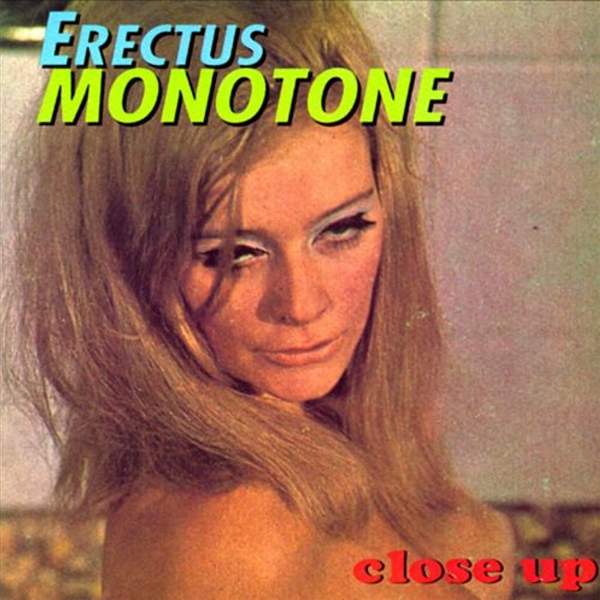
Close Up is the kind of album (or EP? who cares) that is immortal because it is so rooted in its time that, 25 years later, you can never feel the slightest weariness. Perhaps it would be different if we were in 1995, a few months after this album came out. Perhaps we would say it does not vary enough. We would be quite wrong, because with hindsight, Close Up teems with ideas that could inspire post-nineties bands looking for new inspiration.

“William Goat“, the very first, is not the track that takes the most risks. It is nonetheless very effective. E.M. is already in-your-face, nineties beyond measure, and its leaning towards experimental rock can be felt, but it goes fast, eager to show us. This is probably the most Butterglory-ish thing Erectus Monotone ever did. “My First Harmony“, with its fully controlled introduction, is more measured. The voice has crossed over to the male side of the force.

“I Am In The World” is the main reason for this article, there always has to be a track that sparks the urge to write. It is also the one I featured in the mixtape I mentioned in the introduction (you can listen to it below). Erectus Monotone does everything you can expect from 90s excellence. It has enough rhythm to make Bernadette Chirac want to take up interval training, it is dark without being abstruse, it is sensual without dripping.

Then comes “Gilberto” and it is Andy Freeburn who takes flight. There is no denying that she crushes the EP with her vocal power, and when you think back to Close Up a few hours after listening to it, her voice resurfaces straight away. The duo works rather well with Kevin Collins, but she deserves the spotlight.

“Aerospooky Reprise” is an interlude that reinforces the industrial side you sometimes hear. It is ghostly, too. “Gavin & Gunther” follows. It is another Cor-Crane Secret-style demonstration, a kind of art rock that goes hunting on Kim Gordon’s turf. What a high-flying piece! The EP finally closes with “Coffee“. It has never seemed so urgent to dip your lips into something. Ah, the relationship with addiction. You wouldn’t be surprised if there were a slight straight edge influence in this song. Erectus Montone hits too hard not to claim it.

In the end, Close Up magnifies everything we love about the Chapell Hill scene without ever falling, even for a second, into the over-demonstrativeness of the time. Erectus Monotone delivers an EP that suffers from no flaw, worse still, it is so inventive that you wonder why history gets things so wrong. Erectus Monotone’s existence was admittedly short-lived, but 4 years is not bad at all. Merge Records was the flagship label of the scene in the 1990s and, to top it all off, Erectus Monotone had the attitude of the perfect grunge-boy that cool-hunting media loved so much. Why isn’t it better known? Only the deconstructed aspect of its music seems able to explain it.

Erectus Monotone would release other EPs and an album. They are all superb, but I believe Close Up remains its masterpiece. Diggers will not miss the chance to grab some of the copies in circulation. As with a good many nineties bands, posterity seems destined for a small circle. We are proud to be part of it.

Tracklist: Close Up (EP, Merge Records, 1993) 1. William Goat 2. My First Harmony 3. I Am In The World 4. Gilberto 5. Aerospooky Reprise 6. Gavin & Gunther 7. Coffee

Links:

Article on Polvo

Link to all the anachronique articles

Original version (French)

Certains d’entre vous ont remarqué que la récente mixtape Still in Rock, Nineties, Again!, faisait la part belle à plusieurs groupes qui n’ont jamais été chroniquées ici même. Erectus Monotone en fait partie. 
Erectus Monotone est un groupe originaire de Chapel Hill. Est-il le plus grand talent gâché de la scène de l’époque ? Certains le disent. Erectus Monotone, c’est Kevin Collins (guitare et chant), Andy Freeburn (guitare et chant, aussi) et Jennifer Barwick (basse et… chant, parfois). Quant au rôle de batteur, il sera tenu par quatre musiciens différents. Pour la petite histoire, le jour où Dave Brylawski (guitariste de Polvo) a entendu Erectus Monotone pour la première fois, il fut à ce point sous le choc qu’il refusa de repartir en studio : “That was the first we’d ever heard them play with Mike Meadows, and we were blown away, like, ‘Oh my god.’ They came out, and we’re like, ‘No, we’re not playing you the demo“.
Il y a, dans la musique d’Erectus Monotone, un côté très déconstruit qui fait effectivement penser à Slint, Polvo et tous ces groupes de rock indé cathartique. Si le style s’est largement démocratisé, il ne paraissait pas être une évidence dans les années 90s. Mais Erectus Monotone ne joue pas que sur ce terrain. Sa musique, souvent noirâtre et brumeuse, a aussi le côté sensuel de Blonde Redhead ainsi que les mélodies métallurgiques de Sonic Youth. Ça fait beaucoup, me direz-vous, d’autant plus pour un groupe si peu connu. Mais Erectus Monotone ne donne jamais la sensation de fouillis, ses morceaux sont parfaitement faits, bref, voilà bien un indispensable des années 90, malgré son statut d’outsider assumé. 

Comme pour un grand nombre de groupes de l’époque, on semble retrouver une volonté de tuer la pop dans cet album. Surement est-ce le résultat d’un mouvement de balancier qui, pour compenser le trop-plein des années ’80, a voulu produire des albums anti-mélodiques. Comme le dit son label de l’époque, Erectus Monotone voulait jouer une musique “short, sweet, discordant pop with no guitar solos”. Je me demande si la démarche était soutenue par ce dernier ou si, au contraire, il poussait le groupe à se rendre plus “accessible”. Quelle était la mentalité d’alors dans ces labels indé ? Si vous avez un peu de lecture intelligible sur le sujet, je suis preneur (thibault@stillinrock.com). Pour le reste, je suis forcé de constater à quel point Erectus Monotone atteint parfaitement son objectif. Jamais le groupe ne nous offre la moindre éclaircie. 
Close Up est le genre d’album (ou EP ? qu’importe) immortel parce qu’il est à ce point ancré dans son époque que l’on ne peut jamais, 25 ans plus tard, avoir le moindre sentiment de lassitude. Peut-être en irait-il différemment si nous étions en 1995, quelques mois après la sortie de cet album. Peut-être que l’on dirait qu’il ne varie pas suffisamment. Nous aurions bien tort, parce qu’avec le recul, Close Up fourmille d’idées qui pourraient inspirer les groupes de post-nineties à la recherche d’une nouvelle inspiration.

“William Goat“, le tout premier, n’est pas le morceau qui prend le plus de risque. Il n’en demeure pas moins très efficace. E.M. est déjà rentre-dedans, nineties plus que de mesure et son penchant pour le rock expérimental se fait ressentir, mais il va vite, pressé de nous montrer. C’est, probablement, ce qu’Erectus Monotone a fait de plus Butterglory-ish. “My First Harmony“, avec son introduction toute contrôlée, est davantage maitrisée. La voix est passée du côté masculin de la force.

“I Am In The World“, c’est la raison d’être principale de cet article, il faut toujours qu’un titre suscite l’envie d’écrire. C’est également lui que j’ai mis à l’honneur dans la mixtape à laquelle je faisais référence en introduction (vous pouvez l’écouter ci-dessous). Erectus Monotone fait tout ce que l’on peut attendre de l’excellence 90s. Il est sufisamment rythmé pour donner l’envie à Bernadette Chirac de se mettre au fractionné, il est obscur sans être abscon, il est sensuel sans être dégoulinant.

Puis vient “Gilberto” et c’est Andy Freeburn qui prend son envol. Force est de constater qu’elle écrase l’EP de sa puissance vocale, et lorsque l’on repense à Close Up quelques heures après son écoute, sa voix ressurgit sans plus tarder. Le duo fonctionne plutôt bien avec Kevin Collins, mais elle mérite les feux des projecteurs.
“Aerospooky Reprise“, c’est un interlude qui vient renforcer le côté industriel que l’on entend parfois. Il est fantomatique, également. “Gavin & Gunther” prend la suite. C’est une nouvelle démonstration à la Cor-Crane Secret, un genre d’art rock qui va chasser sur les terres de Kim Gordon. Quel haut vol ! L’EP est finalement conclu par “Coffee“. Il n’a jamais semblé si pressant de tremper ses lèvres quelque part. Ah, le rapport à l’addiction. Il y aurait une légère influence straight edge dans ce morceau qu’on ne serait pas étonné. Erectus Montone cogne trop fort pour ne pas s’en revendiquer.


Au final, Close Up magnifie tout ce que l’on aime dans la scène de Chapell Hill sans jamais tomber une seule seconde dans le trop démonstratif de cette époque. Erectus Monotone délivre un EP qui ne souffre d’aucun défaut, pire encore, il est à ce point inventif que l’on se demande pourquoi l’histoire fait si mal les choses ? L’existence d’Erectus Monotone a certes été d’une courte durée, mais 4 années, ce n’est déjà pas si mal. Merge Records était le label phare de la scène en 1990s et, pour ne rien gâcher de notre plaisir, Erectus Monotone avait l’attitude du parfait grunge-boy que les médias à la recherche du cool aimaient tant. Pourquoi n’est-il pas plus connu ? Seul l’aspect déconstruit de sa musique semble pouvoir l’expliquer.
Erectus Monotone fera paraître d’autres EPs et un album. Ils sont tous excellentissimes, mais je crois que Close Up reste sa pièce maitresse. Les diggers ne passeront pas à côté de l’occasion de saisir quelques-unes des copies en circulation. Comme c’est le cas pour bon nombre de groupes nineties, la postérité semble être destinée à un cercle restreint. Nous sommes fiers d’en faire partie.

Erectus Monotone – I Am In The World (1993)

Erectus Monotone – Gilberto (1993)


Tracklist : Close Up (EP, Merge Records, 1993)
1. William Goat
2. My First Harmony
3. I Am In The World
4. Gilberto
5. Aerospooky Reprise
6. Gavin & Gunther
7. Coffee

Liens :
Article sur Polvo
Lien vers tous les articles anachroniques