
Buddy Holly (rock’n’roll)
English version · automatic translation
Anachronique: Buddy Holly (rock’n’roll)
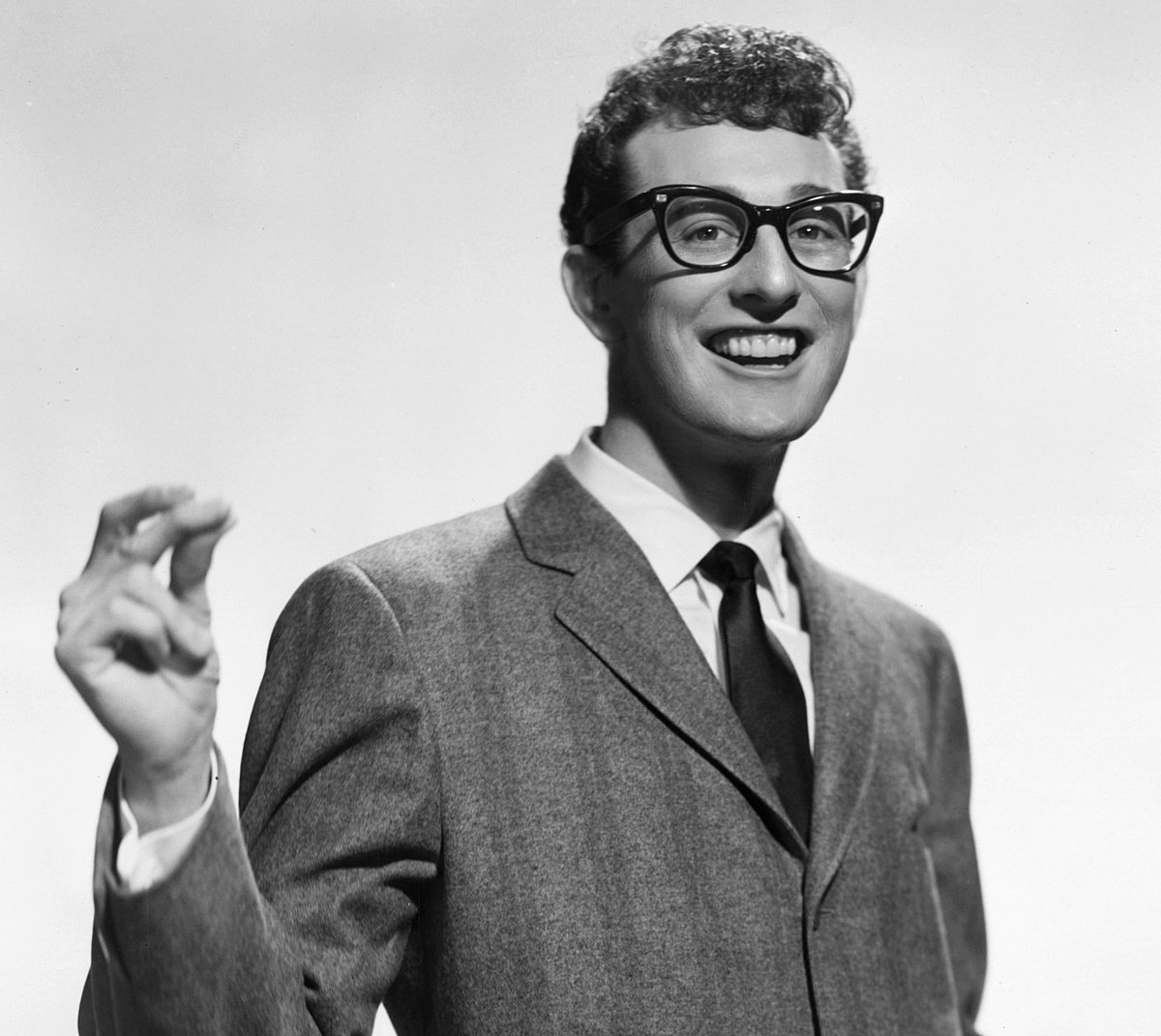
Buddy Holly. Born in 1936 in Lubbock (Texas), died in 1959 in Clear Lake at the age of 22. On February 3, 1959, Buddy Holly and his companions had decided to take a plane at the end of one of their concerts to get to Fargo. The plane crashed, killing all of the passengers. That night went down in history as The Day the Music Died.
Originally, Buddy Holly started a band in high school to play Elvis Presley’s songs. It was in 1957 that Buddy Holly released the first album by his band of the time, the Crickets. Titled The “Chirping” Crickets, this 12-track album contains many hits, including “Peggy Sue” and “Oh Boy!“. You have to remember that in the days of the Crickets, rock’n’roll was considered savages’ music. The Crickets’ songs talk about love and fire off several amorous outbursts. It was a shock for the American continent, one of the very first to show the way of rock’n’roll. Three months later, at the start of 1958, Buddy Holly released his first solo album. It brought together many hits from his time with the Crickets. The re-recording of certain tracks makes it, in my view, Buddy Holly’s greatest essential. Only one album followed it, That’ll Be the Day, also released in 1958.
Buddy Holly, to my mind the best of them all, opens with “I’m Gonna Love You Too“. Buddy Holly’s bouncing voice undeniably recalls the late fifties. Yet this track is incredibly modern. The lyrics were irreverent and the chorus remains a great classic of its time. What’s more, the studio work on this version was innovative, as the mastering plays with echoes on Buddy’s voice. It will not be the last time that happens. Then comes “Peggy Sue“. It is remarkable that this track, surely the biggest hit in Buddy Holly’s entire discography, was not placed first on the tracklist. Buddy Holly takes crazy pleasure in slightly altering the Crickets’ version. He then delivers an excellent guitar solo. This kind of track makes me say that Buddy Holly was one of the first punks. The track is super raw and disconcertingly simple. Lennon himself was not fooled and covered the song on his solo record Rock ‘n’ Roll.
I will skip the next two tracks, pleasant but not the most memorable, to get to “Valley of Tears“. Ah, the beautiful pop ballad. That track must have livened up a few proms. “Valley of Tears” captures, all on its own, the whole of early-sixties America. These few minutes of pop are disconcertingly warm. Capturing all the tenderness in the world in just 2 minutes, that was the crazy bet Buddy Holly had set himself. And then, a minute and a half later, Buddy Holly sets the tone for super rock’n’roll on “Ready Teddy“.
If you want to dispute “Peggy Sue”’s claim to being the best-known track, then it is surely “Everyday” that takes its place. I would like to stop here and put my finger on how ahead of its time this track is. Doesn’t it remind you of anything? Not even a little Beatles? Not even a bit of all that sixties pop? Ah, it must be said that John Lennon and Paul McCartney saw Buddy Holly live when they were teenagers. How many can boast of having influenced the Beatles to that degree? Almost 60 years later, here is one of the greatest tracks in history, and one of the most influential too. It is with no small joy that we then find Buddy Holly’s voice introducing “Mailman, Bring Me No More Blues“. It is all there. The Beatles would cover this track during the Let It Be sessions. Evoking the power of rock’n’roll and how the generation of the time perceived it, it is “(You’re So Square) Baby I Don’t Care” that sets the tone once again. And then comes “Rave On!“. In my Buddy Holly top 5, this track, originally sung by Sonny West, never found a finer interpretation than with Buddy and his Crickets. Note too that the Real Kids, one of the very best punk bands in history, would also do a splendid cover of it (here). That says how undeniable Buddy Holly’s punk force is. He finally leaves us with “Little Baby“, yet another fifties single that suffers no comparison with Elvis.
Buddy Holly’s music is dazzlingly modern. Not only did it capture the youth of an entire era, which would identify with it a few years later, it was also first in a genre. Buddy arrived when everything was still to be done. He helped introduce two guitars on a single track, he delivered some truly grand solos and his melodies would be immortal. His vocal hiccup would be among the most legendary, later taken up by Michael Jackson, Kurt Cobain, Joey Ramone, Jimi Hendrix and many more. He knew how to surround himself with the best people (except the best pilot, admittedly), and everything he touched turned to gold. Whatever he laid eyes on was transformed too, as shown by Bob Dylan who, in 1998, recalled the look Buddy Holly once gave him at one of his last concerts. Let’s not forget the Clash, who mention Buddy Holly in their song “Corner Soul“. We also know that buying a first album is always a milestone in a musician’s life. So what can you say, except that the album by Buddy Holly and his Crickets was Clapton’s first. Finally, it is perhaps Mick Jagger who best summed up Buddy Holly’s full reach, saying “He passed it on via the Beatles and via the Rolling Stones … He’s in everybody“. Yes, Buddy Holly is in each of us.
You can’t help thinking that without that accident, Buddy Holly would eventually have become as famous as the King. Many of his songs are now part of the most classic American repertoire, and his memory is betrayed by no musician. Only, Buddy had in him all the genius that would have established him in everyone’s eyes as one of the greatest of all time (which he is, without question). People often say that the blues is the origin of rock’n’roll. That is partly true. But let’s not forget that well before most of the great bluesmen, a man named Buddy Holly had already got the genre going.
Related links:
Anachronique article on The Supremes
Link to ALL the anachronique articles
Original version (French)
Buddy Holly – Peggy Sue (1958)
Buddy Holly – Everyday (1958)
Buddy Holly – Valley of Tears (1958)
Liens afférents :
Article anachronique sur The Supremes
Lien vers TOUS les articles anachroniques