
Elvis Costello (Pop)
English version · automatic translation
Anachronique: Elvis Costello (Pop)
Elvis Costello is one of the most prolific English artists of his generation. His 30 studio albums undeniably make him one of the unavoidable figures of the scene. And as is often the case, it is his very first effort, My Aim is True, that makes him a true living legend. My Aim is True came out on Stiff Records in 1977, the label of Wreckless Eric, the Damned, Nick Lowe, the Feelies and many more. It was reissued by Columbia the following year. Its producer? Nick Lowe, who would release his Jesus of Cool a year later. So, we often hear the name Elvis Costello, but do we really know him?
My Aim Is True very nearly never saw the light of day. Because of several difficulties in releasing this first album, the label suggested that Elvis Costello put out a split with Wreckless Eric. He refused, which forced him to keep his day job at the time. Then, after a few months of insisting, he finally got My Aim Is True released. Barney Bubbles took charge of the cover, having also worked with Ian Dury, the Damned and Hawkwind. The first two singles were about to start spinning on every radio station in the country. Elvis would soon be on the cover of several magazines. The machine was up and running.
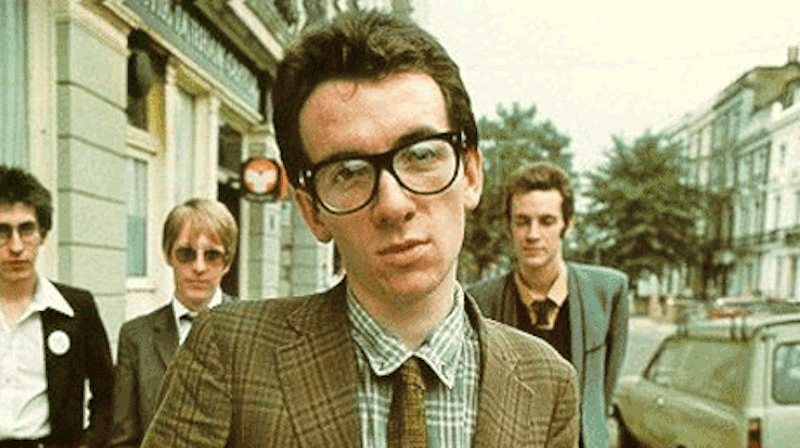
“Welcome to the Working Week” is one of the most Power Pop tracks on the whole album. It introduces Elvis’s pop, at the crossroads of the King (the other Elvis) and the punk of the day. “Miracle Man” is more old school. Perhaps it illustrates even better the look Costello launched on his cover, Buddy Holly glasses on his nose. But that is not the most interesting part. We hear his first crooner ambitions on “No Dancing“. The track is very good, as fifties as you could wish and ultimately quite far from the punk spirit of the time. And it surely helps to have Daniel Hersch on mastering, who worked with Big Star, the Kinks, the Beach Boys, Coltrane and a few hundred others. “Blame It on Cain” picks up the style of the previous track. What could be more beautiful than witnessing the birth of one of the greatest songwriters? See you at the drive-in, the stars will shine tonight with this track.
Then comes the big hit of Elvis Costello’s career, the first song that comes to mind when his name is mentioned, “Alison“. This is the song that starts the tradition of those that would elevate Queen Proms. Its opening “Oh it’s so funny to be seeing you after so long, girl” still resonates, and then comes the album’s reason for being, “Oh, Alison, my aim is true“. Without question one of the best songs of the ’70s, it is a (very) good thing that Elvis Costello decided not to pull his old single from the running order of My Aim Is True. He would earn his stripes with these three minutes. The softness of his voice and his music would set his style, Elvis for life.
“Sneaky Feelings” is bluesier, and it shows why Elvis Costello is often associated with the Pub Rock movement, that of Nick Lowe, Dury and Graham Parker. If the track may seem a little bland at first, trust in the Costello magic, his voice will win you over. “(The Angels Wanna Wear My) Red Shoes” is already more punk, enough to prepare us for the energy of his Power Pop “Less Than Zero“. Was it an inspiration for Bret Easton Ellis’s novel? Whatever the case, “Less Than Zero” stands out in my view as the second masterpiece on My Aim Is True. Its chorus is as unstoppable as the Ramones’ arrival in Rock ‘n’ Roll High School.
That leaves four tracks. The first is “Mystery Dance“, the punk-ish track, more experimental than the others. What a (pleasant) surprise to find such a track on the album. The bridge between the fifties and ’77 is thus built. “Pay It Back” goes for something jazzier with the first appearance of a horn. The whole thing is customary, to say the least. Only Richard Hell knew how to do something in a similar vein. I will skip “I’m Not Angry” to rush to “Waiting for the End of the World“. Visionary, the television society is already depicted with precision. “Everyone was looking for a little entertainment”. The drums lead us energetically toward a fine end of the world / of the album.
A few years after the album came out, NME and Rolling Stones named it in their list of the 500 greatest albums of all time, for what that is worth. We should not forget to mention what came after My Aim Is True, see “I Can’t Stand Up For Falling Down“. Yet it is a small miracle that Elvis Costello is now recognised as one of the big names of the English scene of the time. Not only did his first album arrive amid the competition of 1977, what I like to describe as the best musical year in history, but on top of that it departs quite clearly from punk codes (even if it keeps the attitude). And Elvis was not another boy band, but rather a little guy with glasses who would nonetheless change the face of pop culture.Under the guise of being a sort of product, cover, glasses, attitude, Elvis Costello was and remains an artist capable of turning down success in order to share his true music. His refusal of a split with Wreckless amply proves it. The latter released his “Whole Wide World” the same year, so you tell yourself that, for once, history got things right.
Related links:
Anachronique article on Nick Lowe
Link to ALL the anachronique articles
Original version (French)

“Sneaky Feelings” est plus bluesy et on y comprend pourquoi Elvis Costello est souvent associé au mouvement Pub Rock, celui de Nick Lowe, Dury et Graham Parker. Si le titre peut initialement paraître un peu fade, croyez en la magie Costello, sa voix vous gagnera. “(The Angels Wanna Wear My) Red Shoes” est déjà plus punk, de quoi nous préparer à l’énergie de sa Power Pop “Less Than Zero“. Est-ce une inspiration pour le roman de Bret Easton Ellis ? Quoi qu’il en soit, “Less Than Zero” s’impose à mon sens comme le deuxième chef d’œuvre de My Aim Is True. Son refrain est aussi imparable que l’arrivée des Ramones dans Rock ‘n’ Roll High School.
Il reste alors quatre morceaux. Le premier est “Mystery Dance“, le morceau punk-ish plus expérimental que les autres. Quelle (bonne) surprise que de trouver un tel morceau sur l’album. Le pont entre fifties et ’77 est ainsi formé. “Pay It Back” se veut plus jazz avec la première apparition d’un cuivre. Le tout est pour le moins habituel. Seul Richard Hell savait faire dans un genre similaire. Je passerai sur “I’m Not Angry” pour me précipiter sur “Waiting for the End of the World“. Visionnaire, la société télévision est déjà dépeinte avec précision. “Everyone was looking for a little entertainment”. La batterie nous mène énergiquement vers une belle fin du monde / de l’album.